


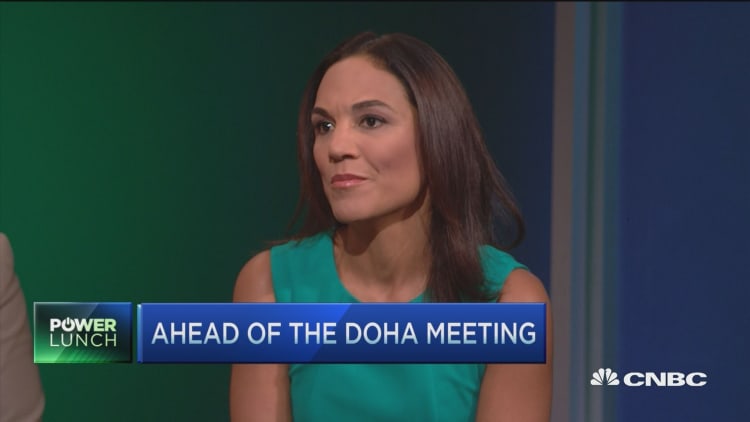
While market watchers are eyeing Iran ahead of Doha, RBC Capital Markets' Helima Croft considers investors' need to worry about Saudi Arabia.
"[Iran is] sending their OPEC representative," the global head of commodity strategy said on Friday, after news emerged that the oil finance minister of Iran will not attend the long-awaited Doha meeting. "[If] the Iranians wanted to get a deal, the OPEC guy could call back to Tehran and they could get the deal done."
Croft said that while Iran is playing political theater by passing on Doha, the Saudis don't want to get a deal done at this point. "They're the biggest wild card to watch," she noted. On the other hand, "if [Saudis] change their position, you get a deal," she told CNBC's "Power Lunch."
In the same vein, founding partner at Again Capital John Kilduff told CNBC that the Iranian minister's absence is a slap in the face to Saudi Arabia, the cartel and Russia. He suggested that an absentee Tehran official only fuels geopolitical issues, which will later prove detrimental for the oil market.
"They've drawn the line on the sand to say that they're going to ramp up this market share come hell or high water," he told "Power Lunch." "The fight is on, if you ask me. That's why I'm unconstructive on oil prices."
While geopolitics drove oil prices to trade in the higher $20 range earlier this year, prices have held in the lower $40 range, causing some to wonder if there's a catalyst ahead.


U.S. oil fell almost 3 percent on Friday, closing down at $40.36. The internationally traded Brent closed down nearly 2 percent at $43.18, ahead of Doha.
Croft believes that an oil output control meeting is considered important, as just a year ago Russia claimed immunity to the crude glut, but this year it has sought out an agreement.
"You have countries like Qatar — Kuwait! — countries that we think are OK, saying, 'We want this deal done'," she said. "In many respects, Saudi Arabia and Iran are the only two holdouts at this point."
Kilduff said on Friday that the oil market is threatened by Iran's quest to reach pre-sanctions output levels. "To me that spells bad news to the oil market; all that supply."
Similarly, Croft said that perhaps other oil producers could allow Iran to cap at "a couple 100,000 more" barrels per day, as the country would need more investments to achieve its output goal.
"You can't do 4 million [barrels per day]. Bow to market realities," she said.
— Reuters contributed to this story.
CORRECTION: Helima Croft works for RBC Capital Markets. The name of the firm was misstated in an earlier version.